Panels are not worklists
A diagnosis code can suggest opportunity. It cannot confirm patient facts, consent, conflicts, or program fit.
IHA Care is the missing operating layer between a patient panel and accountable monthly care—organizing the work, supervision, safeguards, and evidence beside the EHR.
Practice-controlled by design
The system supports decisions; it does not take authority away from the care team.
6
Connected care handoffs
Panel through evidence
360
Synthetic-member scale test
Controlled verification
0
Auto-submitted claims
Billing retains authority
0
Live patient records
Demonstration boundary
The operating gap
Care management fails in the handoffs: who needs attention, what happened, what requires judgment, what is supported, and what must happen next.
A diagnosis code can suggest opportunity. It cannot confirm patient facts, consent, conflicts, or program fit.
The real operation is planning, outreach, coordination, follow-through, escalation, and patient choice.
Clinical judgment, compliance decisions, and claim submission remain with the responsible organization.
Every proposed billing line needs a traceable path back to consent, work performed, review, and exceptions.
One health strategy
Care and HUMA should not be collapsed into one vague “AI health” story. They solve different sides of the same problem—and meet through trusted human relationships.
The care-operations platform
For navigators, supervisors, billing teams, and practice leaders coordinating accountable monthly care.
The 360-day health companion
For people navigating education, reminders, adherence, and the path from screening to appropriate care.
Neither product diagnoses. Neither replaces the patient’s clinician. Each is designed to extend the capacity of accountable people.
How the operation moves
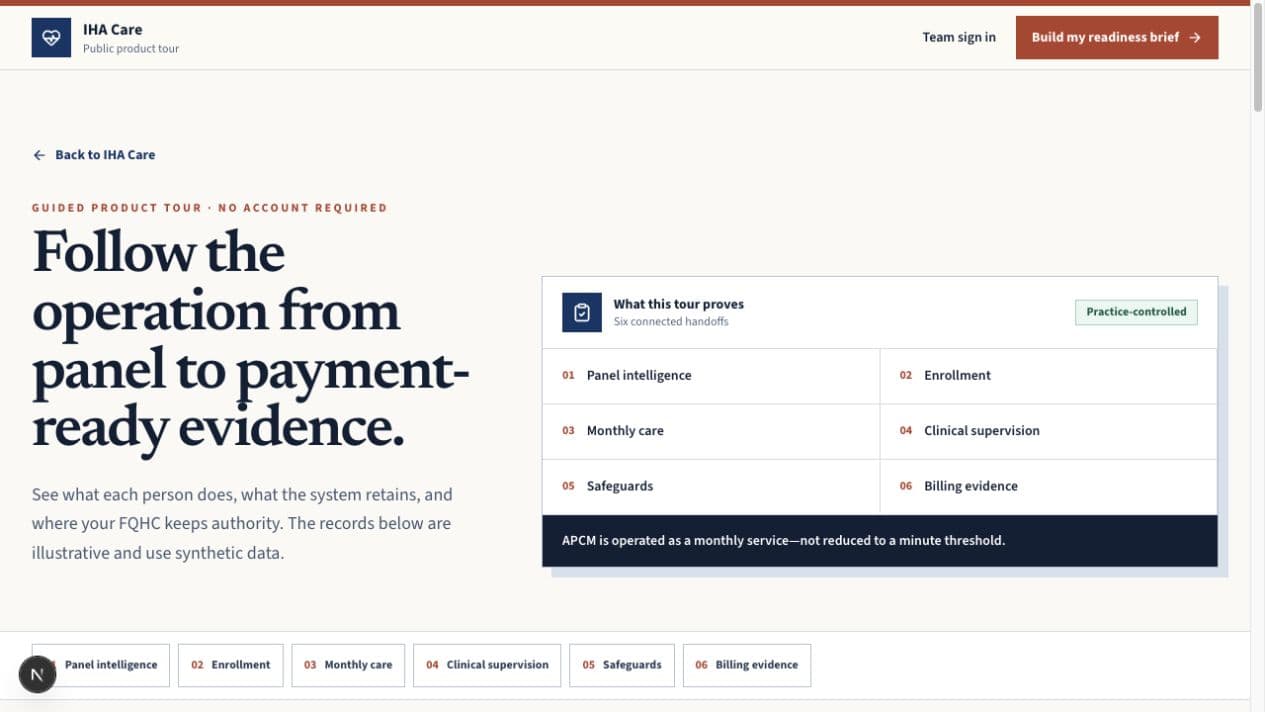
Six connected handoffs make ownership and retained authority visible at every step.
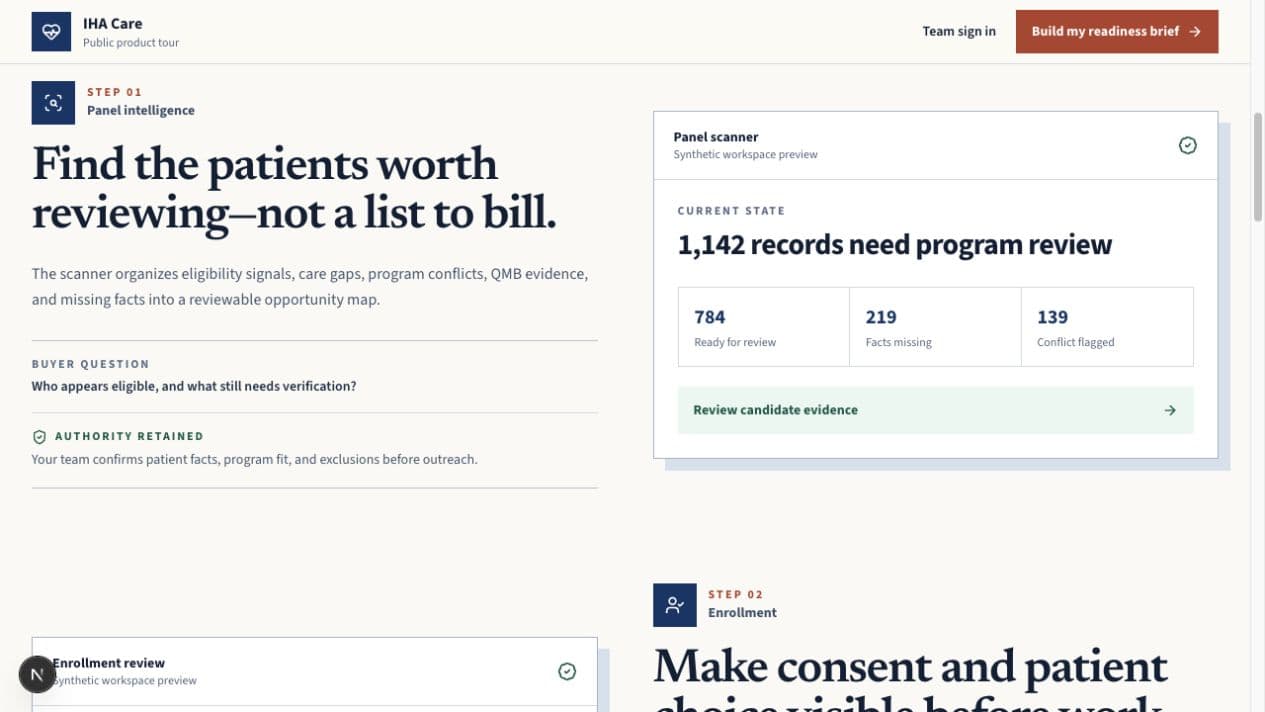
Organize eligibility signals, care gaps, conflicts, and missing facts into a reviewable opportunity map.
Make consent, patient choice, program fit, and unresolved requirements visible before work begins.
Give navigators a ranked list of care, outreach, coordination, and follow-up actions.
Move exceptions to a named licensed professional with the context needed to make a decision.
Hold unsupported work before it quietly becomes a billing line or an unreviewed communication.
Assemble a traceable review packet while the practice retains final coding and claim authority.
Inside the product
The public product surfaces use synthetic information and can be explored without a provisioned team account.
Public product tour
A no-account tour follows the work from panel review through payment-ready evidence.
Panel intelligence
The scanner surfaces what appears ready, what is missing, and what conflicts require judgment.
Practice readiness
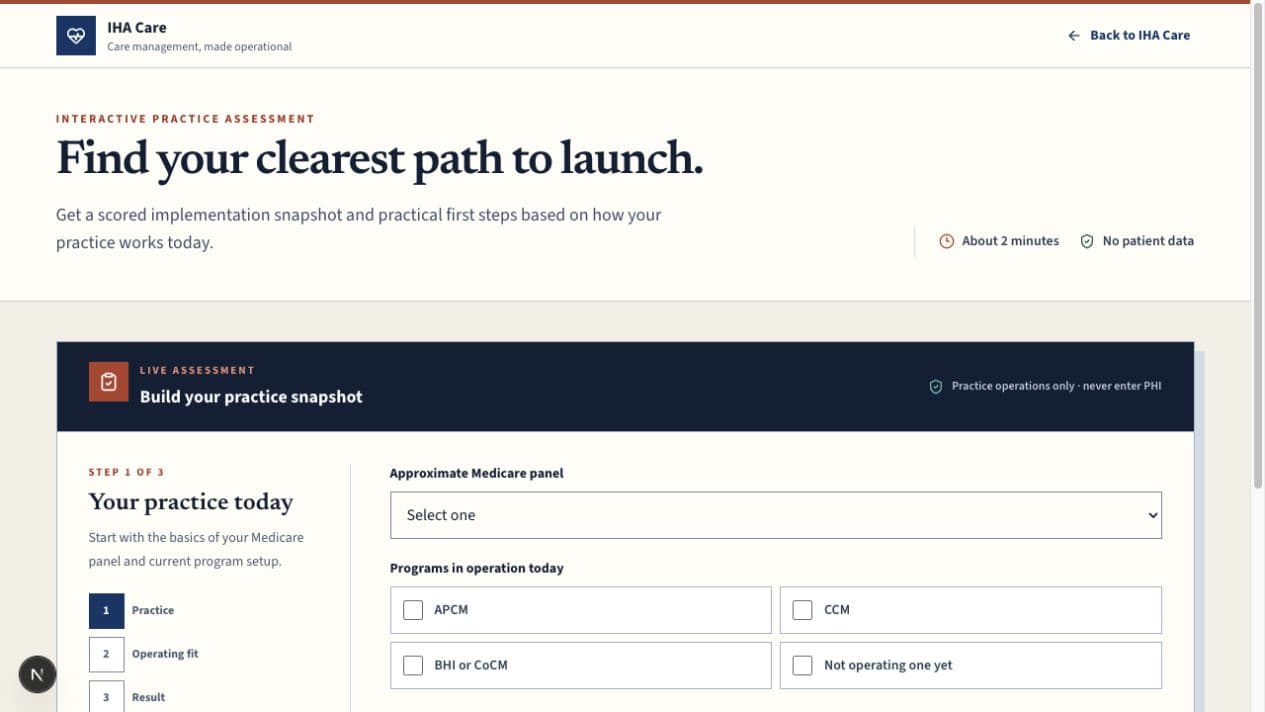
A short assessment maps the practice, operating fit, and next steps without collecting patient data.
Safety architecture
The product is designed to make responsibility more visible—not to disguise automation as judgment.
AI may prepare communications. A navigator accepts, edits, or rejects every draft before sending.
Deterministic escalation runs before any generative path. Emergencies are not a place for a model to guess.
Licensed staff retain supervision, clinical decisions, escalation authority, and final resolution.
The platform assembles evidence. It never autonomously codes or submits a claim.
Evidence ladder
A working product, a controlled pilot, and measured health outcomes are different achievements. IHA reports them separately.
Six connected workflows, human-review gates, safety logic, reporting, and a 360-member synthetic scale test.
A qualified partner, signed agreements, covered infrastructure, trained roles, and bounded acceptance criteria.
No live customer, live patient data, reimbursement result, or patient-outcome claim is represented today.
From case study to operating plan
Map your panel, team, supervision, EHR handoffs, and billing workflow. No patient data required.